
The Weld Head Is Where PACK Output Is Decided
Battery laser welding has become the yield-defining step in module and PACK assembly. A single pack carries thousands of welded joints, each expected to survive a decade of vibration and thermal cycling — inside a sealed enclosure, where a bad weld is not reworkable.
The market has repriced accordingly. Mobility Foresights puts the global battery laser welding market at roughly USD 1.05 billion in 2026, reaching USD 3.1 billion by 2032 at a 19.8% CAGR, while the adjacent weld inspection system market is estimated at USD 1.82 billion in 2026 (360iResearch, September 2026). Inspection is no longer an add-on.
From Spot Welding to Laser: What Changed
Laser joining displaced ultrasonic and resistance welding across most pack-level joint types on four properties that matter on a running line: it is non-contact, so there is no electrode wear loop; it delivers localised heat input that protects neighbouring cell chemistry; cycle times are milliseconds per joint; and it consumes no filler. Joint families now include tab-to-busbar, current-collector foil, can sealing, terminal attachment and pack-level busbar assembly. Tab-to-busbar carries the highest joint count per pack and is the largest single application by process volume, and treating that station as standalone rather than as one node in a connected system is what dates a line fastest (360iResearch, September 2026).
The Copper Problem, and Why Blue and Green Lasers Win
Copper is the persistent difficulty. Infrared fibre lasers handle steel and aluminium well, but copper reflects most infrared light until the surface abruptly melts and absorption jumps — a transition that makes the process unstable and spatter-prone. Green and blue wavelength sources absorb far better in copper and are the fastest-growing category, while beam shaping and oscillation stabilise the dissimilar copper–aluminium joints common in busbars (Mobility Foresights, September 2026). Smart welding systems integrating vision with adaptive parameter control are moving from 31.8% penetration in 2025 to 44.6% in 2026, and Chinese demand for tab and busbar welding equipment grew 21.4% year on year (Chanye Shijie / 产业世界, 15 August 2026).
The 2026 Equipment Market in Numbers
Four research houses converge on one conclusion: the welding station is the fastest-appreciating part of a battery line.
| Metric | Figure | Source |
|---|---|---|
| Battery laser welding market, 2026 | USD 1.05 billion | Mobility Foresights, Sep 2026 |
| Battery laser welding market, 2032 | USD 3.1 billion, 19.8% CAGR | Mobility Foresights, Sep 2026 |
| Full-automatic lithium battery laser welding machines | USD 3.20B (2025) → 3.55B (2026) → 6.51B (2032) | 360iResearch, Sep 2026 |
| Cylindrical full-tab laser welding lines | USD 310M (2025) → 620M (2034), 9.4% CAGR | Intel Market Research, 2026 |
| New installations using AI-optimised laser heads | 68%, cutting cycle time about 25% | Intel Market Research, 2026 |
| Capex, fully automated cylindrical welding line | Above USD 2 million; 3+ year payback | Intel Market Research, 2026 |
That last figure is the reason the gates below matter more than the kW rating on the datasheet: payback is decided by yield, not throughput.

Seven Quality Gates That Decide PACK Yield
Gate them in this order — each one is cheaper to fix than the next.
Gate 1 — Weldability and joint-design study, before the purchase order
Start with a documented weldability study covering material combinations, tolerances, contamination risk and clamping access, then qualify equipment through trials on production-representative materials with agreed acceptance criteria. Buying before this study inverts the risk: you adapt your product to whatever the supplier had on the shelf.
Gate 2 — Fixture and clamping control
Industry process guidance is blunt: fixture positioning deviation above 0.2 mm causes tab misalignment, clamp loosening and localised missed or cold welds, while oxide, oil and dust on tabs blocks metallurgical bonding. Verify clamp pressure on a schedule and control the dwell time between pre-treatment and welding.
Gate 3 — Inline weld monitoring during the weld, not after it
Inline monitoring has moved from optional to standard, because a defective weld inside a sealed pack cannot be reworked. Coaxial heads now collect full-spectrum signals across roughly 350–1,800 nm at sampling rates up to 800 kHz, fusing optical, electrical and vision channels with FPGA-speed analysis to judge quality in real time; higher-end systems add optical coherence tomography for measured depth. Treat monitoring quoted as an upgrade, rather than a default, as a flag.
Gate 4 — 100% contact-resistance verification
Post-weld electrical testing is the fastest quantitative screen for hidden lack of fusion, which AOI cannot see. The widely used industry threshold is ≤50 µΩ; a correctly formed nickel tab weld measures 0.05–0.3 mΩ, and pack programmes often target under 0.15 mΩ. Use a four-point probe so lead resistance does not contaminate the reading, and log per joint.
Gate 5 — Destructive pull testing with a capability target
Resistance alone will not catch a joint that is electrically acceptable but mechanically fragile. Common acceptance criteria for tab welds sit at a minimum tensile load of 80 N. The number that predicts field behaviour, though, is the spread rather than the mean, so Cpk ≥ 1.67 on pull strength is the specification worth demanding.
| Check | Acceptance criterion | Position and coverage |
|---|---|---|
| AI surface inspection | ≥99.5% defect recognition accuracy | After welding, 100% of joints |
| Contact resistance | ≤50 µΩ, often <0.15 mΩ at pack level | Inline or post-station, 100% |
| Tensile pull / peel | ≥80 N tab welds; Cpk ≥ 1.67 | Offline, per batch or shift |
| Traceability record | Per-weld parameters, operator, lot, equipment ID | Every joint, written to MES |
Gate 6 — AI surface inspection with X-ray as the root-cause route
Deep-learning weld inspection separates a good weld mark from a defective one — a missing weld (no mark, blank seam, no melt deformation) from a cold weld (dull, rough mark, local voids) — at reported accuracy above 99.5%. Validate them against destructive tests and calibrated reference samples rather than their own training set; their value is false-negative control.
Gate 7 — Traceability and MES genealogy
Every weld should record its parameter set, and every cell should carry a code tying its grading records to the joint it ended up in — the requirement automotive supply chains formalise through IATF 16949 genealogy, and the gate that turns a bad shift into a traceable lot instead of an unbounded recall.
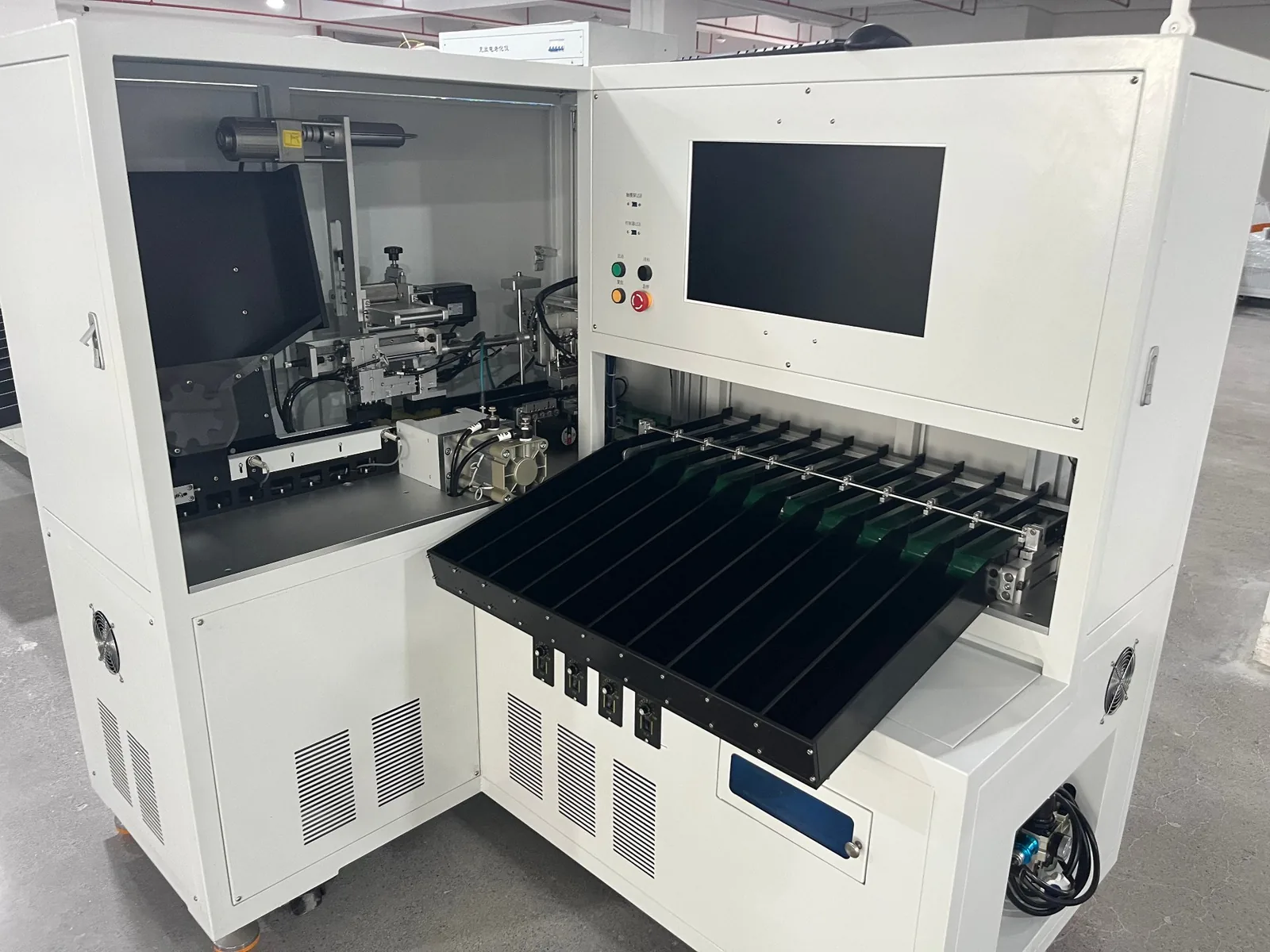
What the Equipment Actually Costs
The laser source accounts for 40–55% of total system cost, beam-delivery optics 15–25%, motion and automation 12–18%, control electronics and software 8–12% (IndexBox, 2026). European pricing gives this reference band:
| Configuration | Reference band (EUR) | What you are buying |
|---|---|---|
| Standard single-beam fibre laser, 2–4 kW | 180,000–280,000 | Baseline welding capability, manual or semi-automatic load |
| Multi-beam or beam-oscillation with seam tracking and process monitoring | 300,000–550,000 | Dissimilar-material stability, copper joining, inline quality signal |
| Premium specification with OCT depth monitoring and auto-calibration | Adds 30–50% to base price | Measured penetration depth and closed-loop control |
Those bands are European and carry local integration and logistics cost, though the component ratios hold. OCT depth monitoring, meanwhile, has moved from optional specification item to baseline expectation.
Who Is Buying in 2026, and Where the Lines Are Going
Order books confirm the thesis. United Winners Laser reported RMB 4.2 billion of new orders in H1 2026, up 91% year on year — its highest half-year ever, with storage growing faster than EV power, and now expects full-year orders to beat its RMB 6.5 billion target. Hymson has taken multiple full-line storage orders, with 587 Ah prismatic storage cell equipment in volume delivery (Securities Times, September 2026). Trade followed: China’s NEV exports reached roughly 2.3 million units in H1 2026, up about 110% (GGII, September 2026).
The clearest example is India: Powertrac has ordered a 10 GWh BESS manufacturing line from Sunka Lead for a plant in Gujarat, running from prismatic cells through module and pack assembly into standard containers covering 10 kWh to 5 MWh. Equipment arrives in November 2026 and production starts in January 2027 — roughly 2,000 units of 5 MWh containerised storage a year, built with AGV material movement, robotic assembly and automated inspection. Welding and inspection stations are now the part of a PACK line buyers examine first.
Six Questions for Your Next Welding-Line RFQ
- Which wavelength, and why? Demand a justification of infrared, green or blue against your material stack — copper content decides it, not preference.
- Is weld monitoring standard or optional? Get the sensing channels, sampling rate and whether correction is closed-loop.
- What Cpk does the supplier commit to? Pull-strength capability on representative samples is the number that predicts yield.
- How long is changeover between cell formats? Modular fixturing and recipe management decide line flexibility.
- Which MES and fieldbus interfaces are native? Per-joint logging should be configuration, not development.
- What does process validation include? Trials on representative materials plus documented acceptance testing and handover.
In every case, you are buying a qualified process rather than a power rating.
The Takeaway: Buy Yield, Not Watts
Shorter wavelengths, smarter beam shaping, AI-assisted monitoring and closed-loop depth control are moving from premium options to baseline expectations. The tolerance for undetected variation is shrinking at the same time, because packs are denser, formats larger and cycle times shorter. Both forces point the same way: the value of a welding station is set by what it can prove about the joint it just made. For a builder entering module and PACK assembly for the first time, a line specified around these seven gates competes on yield against a much larger factory — at a capital cost that does not require a three-year payback gamble.
NEGUP MACHINE supplies cylindrical, prismatic and pouch battery assembly lines, battery assembly equipment including laser welding and precision spot welding stations, and battery testing equipment covering cell grading, pack aging and PACK/module EOL test systems — configured for energy storage, EV and small-format applications to your cell format, joint design and output. Tell us your cell type, joint count and target throughput.
WhatsApp +86 15307690902 | rain@negupgroup.com