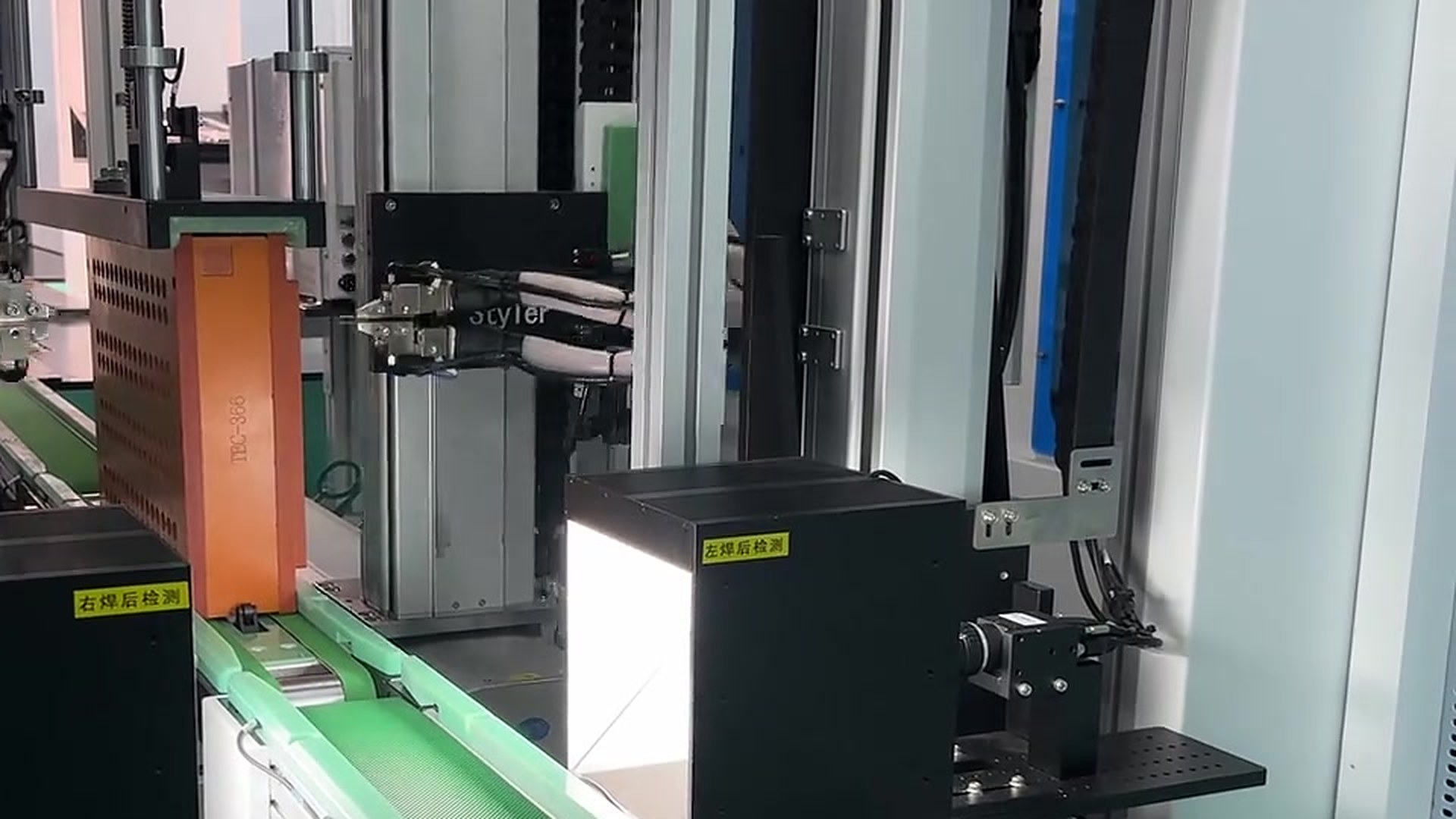
A battery assembly line cost in 2026 starts near USD 220,000 for a 5–30 MWh pilot PACK line and reaches USD 7–18 million for a 350–800 MWh automotive-grade turnkey line, FOB China. Module assembly and welding carries 30–40% and end-of-line testing 18–25% — those two decide your budget.
Send your cell format, annual MWh and automation level on WhatsApp +86 153 0769 0902.
What a Battery Assembly Line Costs in 2026
Two buyers with the same monthly pack output can be quoted a factor of three apart, and the reason is rarely machine quality. A battery assembly line price is set by annual capacity, by how much work servos do instead of hands, and by the station count the flow forces in; published 2026 turnkey pricing from Chinese builders keeps the four bands in a range you can budget against before talking to anyone.
| Line class (turnkey, FOB China) | Annual capacity | Automation level | Reference investment | Typical output, 8 h shift |
|---|---|---|---|---|
| Pilot / R&D small-batch line | 5–30 MWh/year | Manual plus semi-auto | USD 220,000–750,000 | 80–250 packs |
| Semi-automatic commercial line | 30–120 MWh/year | Hybrid: key stations automatic | USD 700,000–2,200,000 | 300–800 packs |
| Mid-scale fully automatic line | 120–350 MWh/year | Full auto with MES integration | USD 2,300,000–6,800,000 | 800–1,800 packs |
| Large automotive-grade line | 350–800 MWh/year | Robotic handling, CTP compatible | USD 7,000,000–18,000,000+ | 1,800–4,000 packs |
| Cross-check: CTP cell-to-pack line, 4 PPM | 1 GWh/year per shift | Automatic, U-shape layout | USD 1,200,000–1,800,000 listed | 1 GWh per shift |
Read the last row carefully: a single 4 PPM cell-to-pack line is advertised at USD 1.2–1.8 million for 1 GWh a year per shift, while the automotive band sits at USD 7–18 million. The gap is not margin — it is station count, redundancy and the traceability layer an automotive customer audits.
Where the Money Goes: Six System Modules
A PACK line is not priced per metre of conveyor. It is priced as six blocks, whose cost shares are stable enough to budget with; module assembly and welding is roughly a third of the project, so the welding process — laser or ultrasonic, at what power — is the first decision that carries a price.
| System module | Share of line cost | Main equipment | Price band (USD) |
|---|---|---|---|
| Cell pre-processing and sorting | 12–18% | OCV/IR tester, grading and sorting machine, cleaning and gluing station | 180,000–950,000 |
| Module assembly and welding | 30–40% | Stacking and framing fixture, compression, laser or ultrasonic busbar welding, busbar assembly | 450,000–6,200,000 |
| Harness, BMS and fastening | 10–15% | BMS assembly station, torque-controlled fastening, harness insertion unit | 140,000–2,100,000 |
| End-of-line advanced testing | 18–25% | HiPot and insulation tester, air-tightness tester, EOL comprehensive pack tester, aging cabinets | 260,000–4,800,000 |
| Vision inspection and traceability | 5–10% | AOI station, laser marking of SN and QR code | 90,000–1,400,000 |
| Conveyor, fixtures, safety and MES | 8–15% | Transfer system, tooling fixtures, safety interlocks, MES and SCADA software | 120,000–2,600,000 |
Two consequences follow. First, the testing block at 18–25% is not overhead you can trim without shipping defects: it is where the end-of-line test system and the air-tightness gates live — the cheapest insurance in the project. Second, the sorting block is the smallest line item that changes pack life most, because unmatched cells drive warranty returns; read how sorting sets module yield before you cut it.
The Five Cost Drivers That Move Your Quote
Once the capacity band is fixed, five specification choices explain nearly all the remaining spread between two quotations — each with a published cost impact, and each a decision to make deliberately rather than inherit from a vendor template.
| Cost driver | Effect on capital cost | What it buys |
|---|---|---|
| Cell format | Prismatic line 25–40% more than cylindrical at equal throughput | Heavy-duty fixtures, pole clamping, high-power laser welding instead of resistance welding |
| Automation depth | Full robotic automation adds 60–120% | Fewer operators, stable takt across the shift, higher first-pass yield |
| High-voltage and safety class | Adds 12–22% above 800 V automotive grade | HVIL hardware, upgraded HiPot test, automatic fire suppression |
| Traceability and MES | Adds 7–15% | Per-pack SN binding, test data logging, SCADA integration, audit evidence |
| Liquid-cooled pack compatibility | Adds 8–18% | Cooling plate air-tightness test, liquid-cooling assembly stations |
The trap is treating every driver as a yes. A stationary-storage pack builder does not need 800 V automotive safety hardware, and a single-order builder does not need a full MES stack. Spend on the drivers your customer audits, defer the rest, and buy the line so those blocks can be added later without rebuilding the flow — our battery assembly line range is specified this way.
Semi-Automatic or Fully Automatic: The Payback Arithmetic
This is the decision most projects get wrong, argued on equipment price instead of loaded labour and yield. Published comparisons put the semi-automatic line at RMB 1.2–1.5 million and the fully automatic at RMB 3–4 million for the same product; five saved operators alone close most of that gap.
| Metric | Semi-automatic line | Fully automatic line |
|---|---|---|
| Operators per shift | 6–8 (8–12 on cylindrical cell lines) | 2–3 |
| Modules per 8 h shift | About 180 | About 420 |
| Format changeover | About 2 hours | 15–18 minutes |
| Weld yield, typical first run | About 92% | 97.5% with vision positioning |
| OEE after upgrade | About 62% | About 81% |
| Defect and rework rate | 2.5% of modules | Below 0.8% |
| Published payback | 12–18 months from labour saving alone | 18–36 months including quality gains |
The project data is consistent: a 45-operator semi-automatic line versus an 8-operator automatic reported annual direct labour from RMB 13.5 million to 2.4 million, output up 140% and defects down from 2.5% to 0.8%. The rule: below roughly 5,000 modules a month, semi-automatic is the rational choice; above it, automation pays. A hybrid layout reaches about 85% of the automatic output for 60% of the investment.
Cost per GWh: The Benchmark Buyers Should Use
Cell makers and pack builders have converged on a simpler unit than the machine price: dollars per gigawatt-hour of installed capacity — the only number that lets a 40 MWh line and a 4 GWh plant be compared.
| Scope | 2026 benchmark | Source |
|---|---|---|
| Complete integrated line, cell to module and pack | USD 35–55 million per GWh | IndexBox, 2026 |
| LFP-focused line, simpler electrode processing | USD 35–42 million per GWh | IndexBox, 2026 |
| NMC and high-nickel line, stricter dry room | USD 45–55 million per GWh | IndexBox, 2026 |
| Integrated gigafactory line, 10–20 GWh | USD 350–550 million total | IndexBox, 2026 |
| Pack assembly only, excluding cell making | USD 1.5–3.5 million per GWh | Pack line practice data, 2026 |
| 320 Ah class cell line versus 280 Ah | Per-GWh equipment spend about 11% lower | GEP Research, 2026 |
| Global PACK automation equipment market | USD 48.5 billion in 2026, up 18.3%; China 66% | IIM, 2026 |
| Module and PACK assembly equipment, China | USD 3–4 billion in 2026 | IndexBox, 2026 |
The last two rows matter to buyers in 2026. PACK automation demand is growing 18.3% a year, cylindrical lines the fastest slice at 22.5%, and Chinese suppliers hold roughly two-thirds of the market. That is a buyer's market for price discovery but a seller's market for delivery slots — so negotiate lead time, not discount. A 320 Ah class line also buys 11% more capacity per gigawatt-hour than a 280 Ah line.
Six Costs the Quotation Does Not Show
The equipment price is the smallest number in the business case that buyers under-estimate. The others are real, and a supplier who will not itemise them is not helping you build a model.
Installation and commissioning adds 15–25% outside Asia versus Asian factory-gate labour. Training and ramp-up costs 100,000–300,000 USD in the first months; model a new line at 70–80% OEE for its first six. Maintenance runs 50,000–150,000 USD a year, and with equipment generations turning over every 18–24 months, spares availability is a ten-year question. Utilities and dry room can add 10–20% if any adhesive or coating step is involved. Acceptance testing means travel, a trial run on your own cells and the days to close what it finds. Freight, duty and insurance turn a FOB quote into a landed cost that can differ 8–15% by destination.
How to Write an RFQ That Puts Cost Where It Belongs
"Please quote your best PACK line price" produces incomparable offers. Price the line on the six modules and the five drivers instead. Name capacity in MWh and packs per shift, the automation level and store count, your three year-one formats, and the acceptance test as a contract number: first-pass yield, sorting accuracy, weld pull strength, HiPot leakage and changeover time.
The Takeaway: Buy the Line That Holds Its Nameplate
A battery assembly line cost is not the quotation number; it is the per-good-pack number after a year of shifts. The 2026 bands are clear enough to budget against — USD 220,000 at the pilot end, USD 2.3–6.8 million for the mid-scale automatic line most builders need, and USD 7–18 million at the automotive end. Spend where it changes yield — the welding and testing blocks, the fixtures that set alignment, the automation that holds takt at hour seven — then fix the acceptance tests before you sign. NEGUP MACHINE builds battery assembly lines and battery testing equipment for cylindrical, prismatic and pouch cells — from the NG-001 cylindrical line and NG-002 prismatic line to the NG-004 sorting machine, NG-013 grading machine and NG-014 PACK aging machine.
WhatsApp +86 15307690902 | rain@negupgroup.com
Frequently Asked Questions
How much does a battery assembly line cost in 2026?
Turnkey PACK lines run from about USD 220,000 for a 5–30 MWh pilot line, through USD 700,000–2.2 million for a 30–120 MWh semi-automatic line, to USD 2.3–6.8 million for a 120–350 MWh fully automatic line and USD 7–18 million at automotive grade; cell manufacturing equipment is a separate, larger budget.
Which module of the line costs the most?
Module assembly and welding, at 30–40% of the line budget, followed by end-of-line testing at 18–25%. If testing shows below 15%, ask which tests were dropped — send it to us on WhatsApp and we will map it against the standard EOL sequence.
Is full automation worth the extra cost?
Full automation adds 60–120% to equipment cost but cuts operators from 6–12 per shift to 2–3 and lifts first-pass yield from about 92% to 97.5%. Published payback is 12–36 months; below roughly 5,000 modules a month semi-automatic wins. A hybrid line reaches about 85% of the output for 60% of the investment.
What should a line quotation include?
Capacity in MWh per year and packs per shift, automation level and station count, cell formats, the station list, acceptance tests with yield and accuracy targets, commissioning and training scope, warranty and spares. Ask for freight, installation and duty separately — rain@negupgroup.com or WhatsApp +86 153 0769 0902.